
A California-based biotechnology company has secured a landmark regulatory clearance in transplantation medicine: on July 1, 2026, the United States Food and Drug Administration approved Tregzi — the world’s first regulatory T (Treg) cell–based immunotherapy — for improving chronic graft-versus-host disease (GVHD)–free survival among adult blood cancer patients who undergo donor stem cell transplants.
The approval was granted to Orca Biosystems, Inc., headquartered in California, and addresses what specialists have long considered one of the most feared and difficult-to-manage complications in transplantation medicine. Even when a stem cell transplant successfully clears the original cancer, donor immune cells can turn against the recipient’s body — a condition known as chronic GVHD that diminishes survival prospects and quality of life for many patients.
The Challenge of Chronic GVHD in Blood Cancer Treatment
Allogeneic hematopoietic stem cell transplants — procedures that rely on blood-forming cells from a genetically compatible donor — are among the most powerful tools available for treating blood cancers such as acute leukemia and myelodysplastic syndrome. Yet this life-saving procedure carries an inherent risk: the transplanted immune cells may identify the recipient’s own tissues as foreign and mount a sustained attack against them.
Chronic GVHD can emerge after a transplant that otherwise appears successful, leading to prolonged illness and significantly reduced survival. Standard transplant protocols have historically offered limited protection against this complication, leaving patients and clinicians with few preventive options.
How Tregzi Is Designed to Work
According to the FDA, Tregzi is administered after the patient undergoes chemotherapy conditioning — the preparatory treatment that clears the way for donor cells to take hold. The therapy is composed of three distinct cell populations, all harvested from a single donor’s blood: purified blood-forming stem and progenitor cells, regulatory T (Treg) cells, and conventional T cells.
Eligibility requires an 8/8 HLA match between donor and recipient — meaning the two individuals share closely aligned immune-system markers across eight critical genetic loci, whether the donor is a related or unrelated individual.
Treg cells are known for their role in moderating immune activity and sustaining immune tolerance within the body. By incorporating them directly into the transplant preparation, Tregzi is designed to allow the recipient’s blood and immune systems to rebuild after transplant while reducing the probability that donor cells will recognize the patient’s tissues as foreign and initiate an attack.
PRECISION-T Trial Data Underpins the Approval
The FDA’s decision rests on findings from the PRECISION-T trial, a randomized clinical study enrolling 187 adults diagnosed with blood cancers — including acute leukemia and myelodysplastic syndrome. According to the FDA, participants were randomly assigned to receive either Tregzi or a conventional stem cell transplant.
The trial’s primary endpoint measured chronic GVHD–free survival: the time from transplant to either death from any cause or the first occurrence of moderate or severe chronic GVHD, assessed over a two-year window.
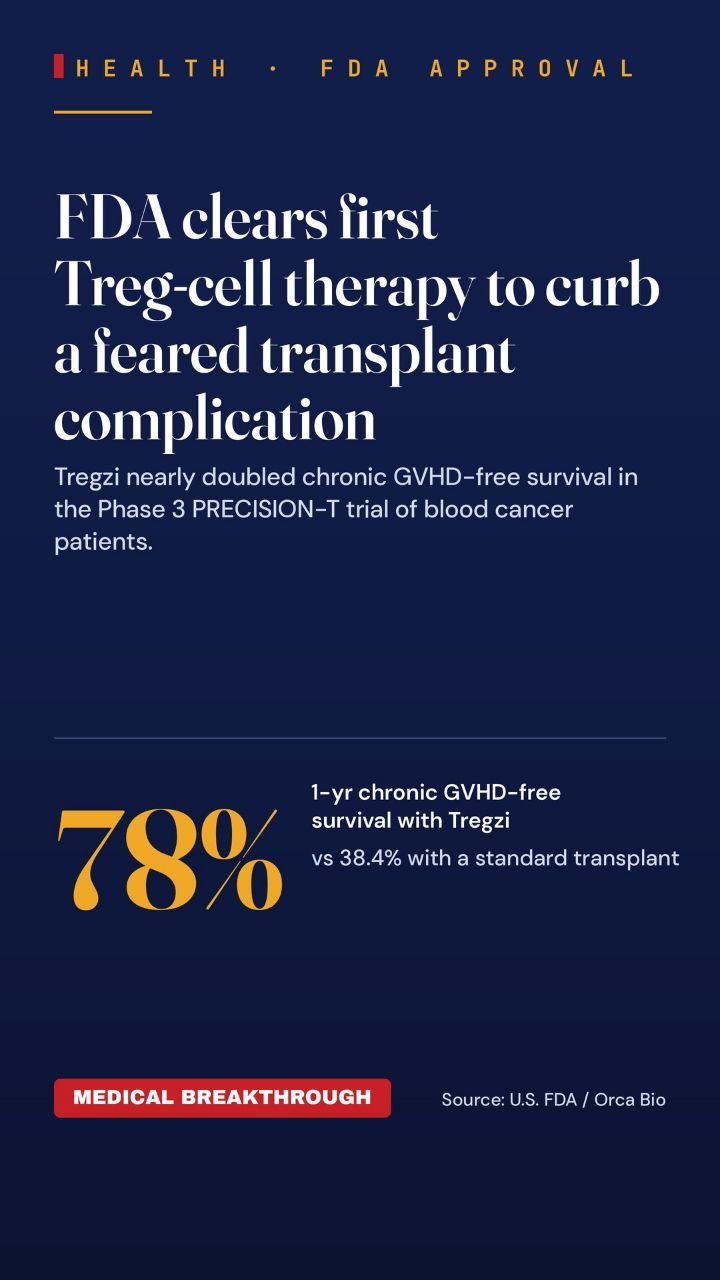
Results at the one-year mark were striking. The FDA reported that 78 percent of patients in the Tregzi arm achieved the primary endpoint, compared with just 38.4 percent among those who received a standard transplant. When accounting for death as a competing risk, only 12.6 percent of Tregzi recipients developed serious chronic GVHD within one year — against 44 percent in the standard-transplant group. The FDA concluded that these data demonstrate that the benefits of Tregzi outweigh its known risks.
Safety Profile: What the Trial Revealed
According to FDA prescribing information, the side effects observed in the PRECISION-T trial were broadly consistent with those expected during stem cell transplantation procedures, with infections being the most frequently reported adverse event.
Two particularly reassuring findings emerged from the safety data. No patient experienced a severe adverse reaction during the Tregzi infusion itself, and no cases of graft failure — the serious complication in which transplanted cells fail to engraft and function — were recorded throughout the study period. Both Orca Biosystems and the FDA advise clinicians and patients to consult the complete prescribing information for comprehensive safety and dosing guidance.
Acting FDA Director Describes What the Approval Represents
Karim Mikhail, Acting Director of the FDA Center for Biologics Evaluation and Research, described the clearance as a genuine therapeutic advance. In a statement, Mikhail said that chronic GVHD has long stood as one of the most feared and hardest-to-prevent complications for blood cancer patients requiring stem cell transplantation, and that the approval offers a new approach capable of helping reconstitute the immune system while substantially reducing that risk. Mikhail added that the approval reflects the broader promise of what cellular therapy can deliver for patients.
Special Designations Recognized During Development
The FDA granted Tregzi two special development designations prior to approval, according to agency records. The first is Orphan Drug designation, which is awarded to therapies targeting rare diseases and provides regulatory and financial incentives intended to encourage development of treatments for conditions that might otherwise be overlooked. The second is Regenerative Medicine Advanced Therapy (RMAT) designation, a status reserved for cell and gene therapies that demonstrate early clinical evidence of addressing serious or life-threatening conditions.
Together, these designations reflect the FDA’s acknowledgment that adult blood cancer patients undergoing stem cell transplants represent a medically underserved population facing significant unmet needs — particularly in preventing transplant-related complications that can persist long after the original cancer has been treated.
By the Numbers
- 187 — adult blood cancer patients enrolled in the PRECISION-T randomized clinical trial
- 78% — proportion of Tregzi patients who achieved chronic GVHD–free survival at one year
- 38.4% — proportion of standard-transplant patients who achieved GVHD–free survival at one year
- 12.6% — Tregzi patients who developed serious chronic GVHD within the first year
- 44% — standard-transplant patients who developed serious chronic GVHD within the first year
- 8/8 — HLA compatibility points required between donor and recipient for Tregzi eligibility
- 2 — special FDA designations conferred on Tregzi: Orphan Drug and Regenerative Medicine Advanced Therapy
Why This Matters
Tregzi’s regulatory clearance marks the first time any Treg cell–based therapy has been approved by a major drug authority specifically to reduce chronic GVHD — a complication that has resisted effective prevention under standard transplant protocols for decades. The PRECISION-T trial demonstrated that Tregzi more than doubled one-year GVHD–free survival rates — from 38.4 percent with standard transplants to 78 percent — while reducing the incidence of serious chronic GVHD from 44 percent to 12.6 percent. For adult patients with acute leukemia, myelodysplastic syndrome, and related blood cancers whose post-transplant options have historically been limited, the availability of this novel cellular therapy represents a clinically meaningful step forward in survivorship and quality of life.
Source: Originally reported by the FDA and Orca Biosystems, Inc.